

If you like classic rock music, you may have heard of the America song, “A Horse with No Name”. Growing up in El Paso, Texas and then living in Utah, the lyrics have always had an impact upon me as I see much more in the desert than what first appears.
“On the first part of the journey
I was looking at all the life
There were plants and birds and rocks and things
There was sand and hills and rings
The first thing I met was a fly with a buzz
And the sky with no clouds
The heat was hot and the ground was dry
But the air was full of sound
I’ve been through the desert on a horse with no name
It felt good to be out of the rain
In the desert you can remember your name
‘Cause there ain’t no one for to give you no pain
La la la la la
La la la la la
La la la la la
La la la la la
After two days in the desert sun
My skin began to turn red
After three days in the desert fun
I was looking at a river bed
And the story it told of a river that flowed
Made me sad to think it was dead
You see I’ve been through the desert on a horse with no name
It felt good to be out of the rain
In the desert you can remember your name
‘Cause there ain’t no one for to give you no pain
La la la la la
La la la la la
La la la la la
La la la la la
You see I’ve been through the desert on a horse with no name
It felt good to be out of the rain
In the desert you can remember your name
‘Cause there ain’t no one for to give you no pain
La la la la la
La la la la la
La la la la la
La la la la la
After nine days I let the horse run free
‘Cause the desert had turned to sea
There were plants and birds and rocks and things
There was sand and hills and rings
The ocean is a desert with it’s life underground
And a perfect disguise above
Under the cities lies a heart made of ground
But the humans will give no love“
For a kid from West Texas, those lyrics come into my head whenever I spend time in the desert. If you study the song’s lyrics, those verses can have many meanings. But I like to think of the most obvious ones. Many people only see the lack of lush vegetation, the heat, the bleakness of the landscape, the harshness of the entire area
But like the song, I see so much more. I see an incredible diversity of life popping up in nearly every little place. I see the struggle to survive in such a harsh climate. That shows me how important life really is for us all. And I see how fragile life is – a couple of drought years and even some of the hardiest of species ends up as nothing more than a skeleton or a twisted remnant of an old tree. That makes me think about how important everything on our planet is, and how everything is so intertwined.

Back in April, I did a camping trip out in the west desert of Utah. I drove out west of the Salt Lake City Metro area on the old Pony Express route.
(I’m not going to go into a detailed Pony Express history here. But, for those of you who don’t know anything about the US Pony Express service, it was an express mail delivery service started in 1860 that ran from the west coast of California to Missouri. The mail was carried by mounted horse riders, and there were stations placed about every 15 miles [24 km] for the rider to get a fresh horse, food, sleep or change off with another rider. The service only ran for about 18 months before it was superseded by the telegraph. But the Pony Express is forever embedded as a part of the western US heritage.)
The route is a dirt/gravel road, that follows the old Pony Express trail. (While you could navigate most of the route in a two wheel drive car, I would not recommend it. The traction is much less of an issue than the rock damage to a car from the dozens of miles across the unimproved roads. However, if the roads are wet, that dusty clay quickly becomes a slippery quagmire providing zero traction.)
I spent the first afternoon and night out at Simpson Springs, a Pony Express station. There is a Bureau of Land Management (BLM) campground there. The campground has no services other than a fire pit, and public restrooms although there are a handful of fresh water spigots from thet natural spring.

I took a hike that afternoon, then took some sunset photos that evening. There was a little two-track trail that took off to the southwest from the Simpson Springs campground. So, I just followed the trail for a while and then trekked downhill from the trail back to the Pony Express Road then east back to camp. Later that night I tried my luck with some star photos, but let me just say that they won’t show up here.

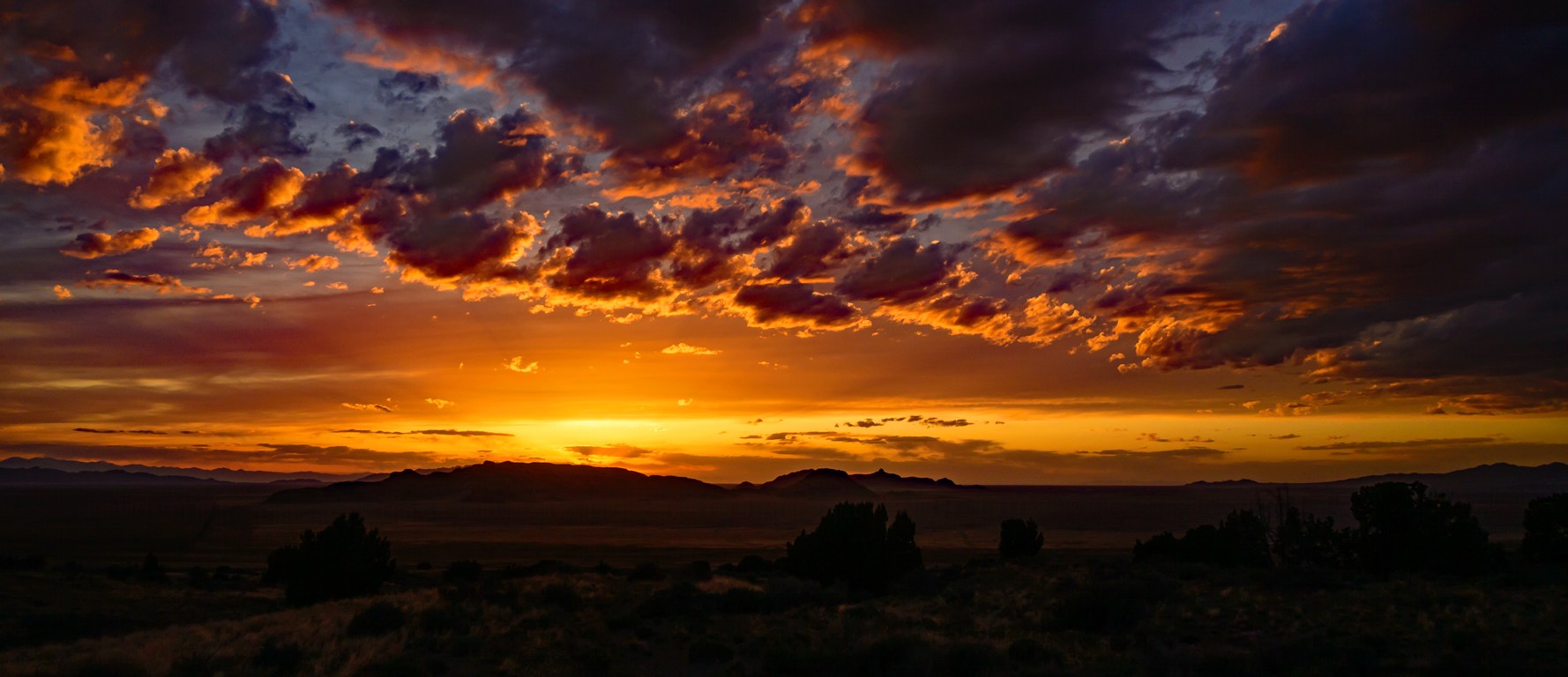
However, that day the skies were filled with some high clouds moving through, and that provided me with an absolutely incredible sunset. Those clouds really picked up the colors that evening but left the western sky clear enough for a wonderful sunset.

If you have been following my blog for a while, you may know that I have been having a difficult time dealing with the new federal government here in the US. So, the campground experience just wasn’t doing it for me. There were people and too many distractions. I went to the desert to take it all in, to refresh my soul; I didn’t want anyone “giving me pain.”

Wanting a more isolated adventure, I left the Simpson Springs area the next morning, and drove out much farther west along the Pony Express route, and finally found another trail heading southward. I could see some black hills to the south, so I followed the trail until it wound away from the hills, then found another little two-track trail that led right back into the hills. There, I located a nice camping spot among some large juniper trees.
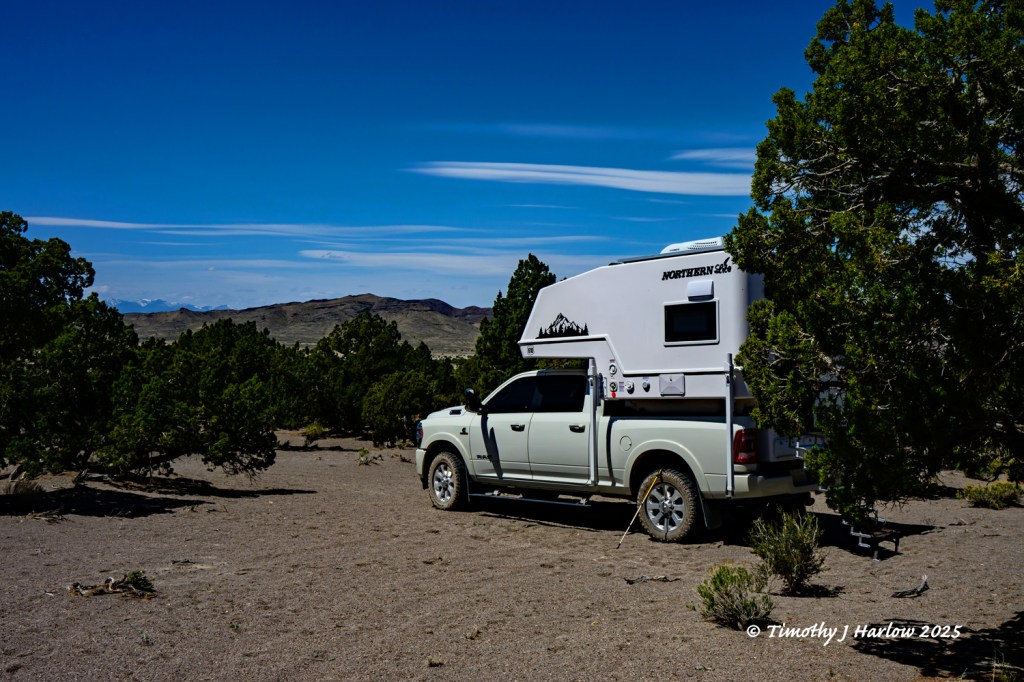
This spot was so perfect! There was no one around. I had not seen another vehicle, or human, since I left the Pony Express trail. After lunch, I decided to hike up into the hills to the east of my campsite. The terrain here was quite interesting. Where I was camped, the soil was mostly deep sand. (I had to put the truck in 4 low to keep from digging ruts into the sand.)
However, as I hiked upward into the hills, the ground changed into a heavy desert pebble cover. Yet, those juniper trees seemed well adapted to both the rock and the sand.

It was fairly windy the whole time I was out in the west desert, so the clouds and sky kept changing.
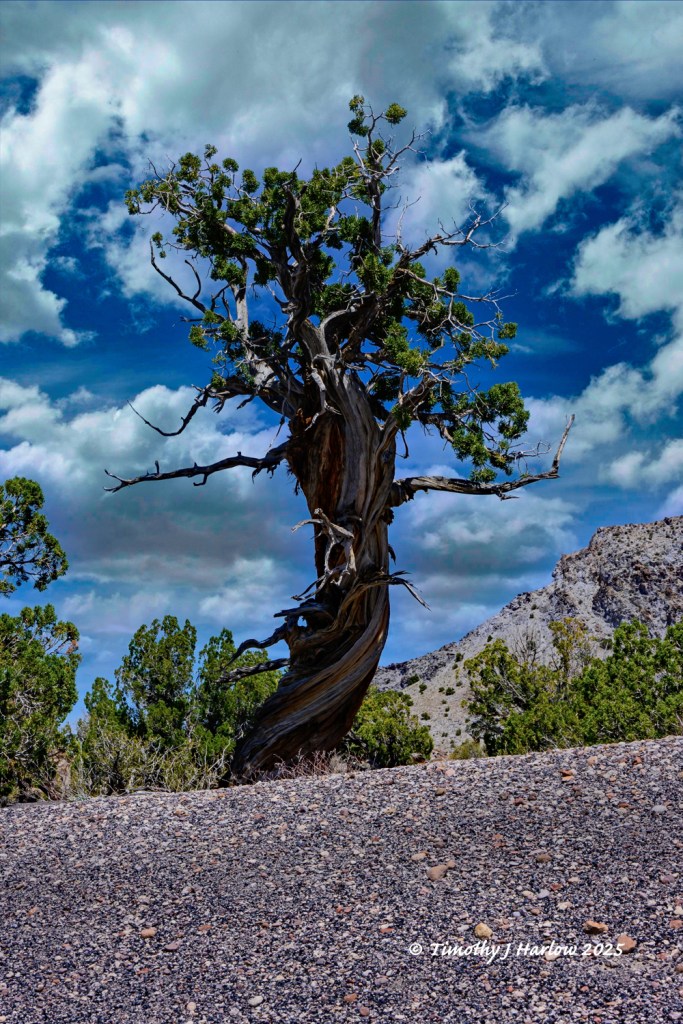
As I got farther along on my hike, I encountered more interesting terrain. Those black hills were old lava, surviving eons of scouring by the relentless desert winds. And in those hills, I found some ancient lava flows poking up through the dirt.

But against this harshness was so much new life – young juniper bushes, spring grasses, cacti, lizards, rabbits and so much more. Just like the song’s verses. I find it quite fascinating to see how much different the desert landscape can be, even just several yards from one place to another.
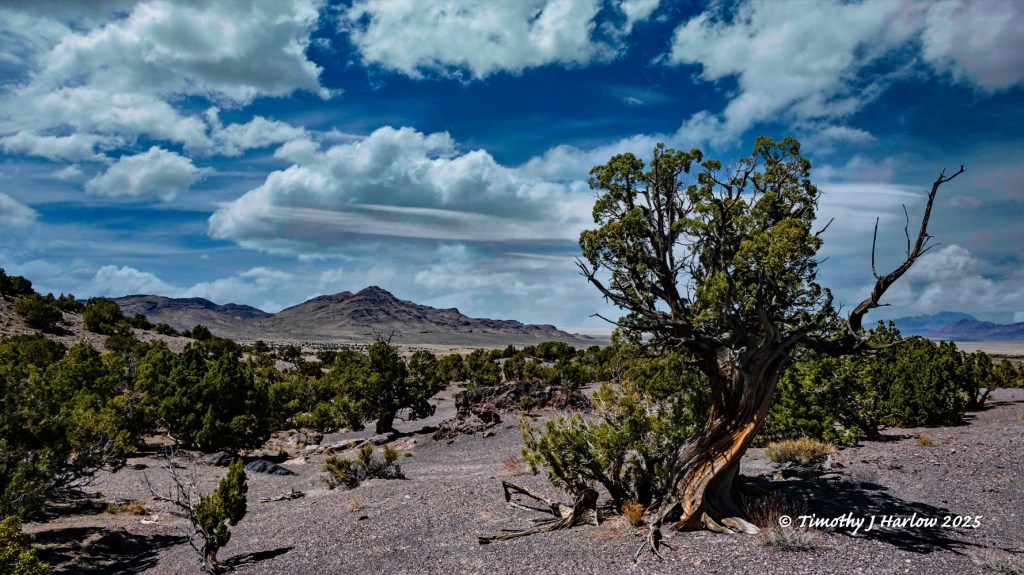
In the valley where I was camped the ground was very sandy with not much vegetation growing between the juniper trees. But just up the hills a couple of hundred yards the ground was no longer really sandy, but covered in what I would describe as a gravel. And much of that gravel were little bits of lava rock. Then up on top of the ridgeline, there was more small plant growth with more varied rocks.

In the photo above, the darker mountains in the background are the Fish Springs Range which lay just west of Fish Springs, an oasis like area where there is a federal wildlife refuge fed by vast underground springs. If you look closely at the shiny spot between the first range of hills and the dark mountains in the background (the Fish Springs Range), it is either the Fish Springs water ponds or the salty barren wasteland to the south of the ponds.
And those snow covered peaks in the far background are the Deep Creek Range just on the Utah side of the Utah/Nevada border. These mountains have one peak over 12,000 feet (3657 meters). While this may not be the most artistic of shots, I love this photo because it almost perfectly illustrates that America song.
In one photo you can see the numerous small plants, the rocks and that struggling, grizzled old juniper tree. Then farther back in the same photo you can make out the lava rock in those hills. And then you can finally see the high alpine environment of those 12,000 foot high Deep Creek Mountains. This is why the desert can be so fascinating!
After returning from my hike, I spent the rest of the afternoon reading and thinking about what went wrong with my star photos from the previous night. I had some nice dinner, and read more until the sun started to head down for the evening.

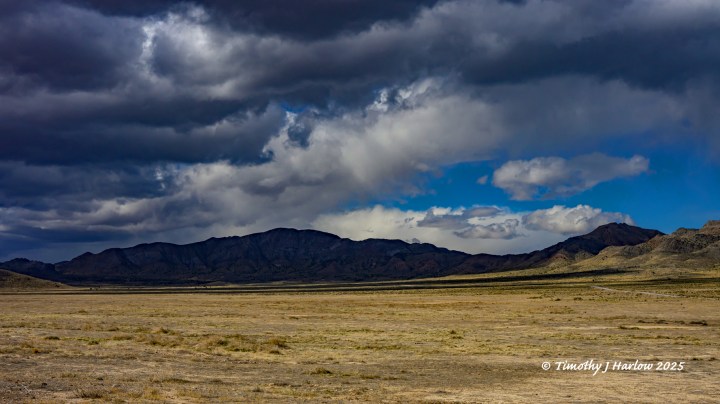
It’s quite interesting to see how much the light changes the character of the desert. I took the photo below right after I reached the first hill on my afternoon hike. At that time of day the sun had burned off a lot of the clouds, so this shot really portrays the more bleak, harsh side of the Great Basin desert.

Anyway, back to the evening photos. By the later afternoon and early evening, those clouds had returned. But the clouds were quite thick right west where the sun was setting, so I never saw the intense sunset colors from the night before. But here is what I did capture from a clearing near the trail into my secluded camp spot.

As cloudy as the evening was at sunset, I was disappointed as I was thinking that there would be no star shots for this trip. So, I went to bed after some more reading. Later than night, I woke up and could see tons of stars outside through the skylight above my bed. I thought, “OK, let’s go do this.” There was no moon, no city light contamination, and the sky had cleared quite a bit. So, here is my “starry night” shot.
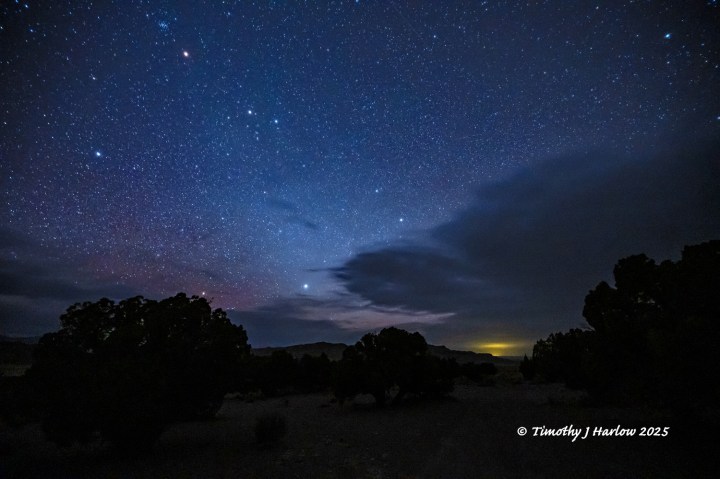
This was a fun project. I used the ultra-short zoom lens I have for my full frame Nikon. I shot this image at 14 mm at f4 for 30 seconds at ISO 6400. The northern sky was still mostly cloudy, but at least toward the west to northwest the sky was quite brilliant. (The original full resolution image is more striking, but I think this is not bad for one of my first real night shots.) I didn’t even realize when I took the photo that at about 11 to 11:15 pm, that you could still see just a hint of the last sunset in the photo. (That’s what 30 seconds of exposure gets you – things you can’t see with the naked eye.)
So, as the next morning was Sunday, I broke camp and started the drive back home. All that wind the day before had pushed in a cold front, and I was just ahead of a pretty strong spring storm.
Later that morning as I was crossing Lookout Pass in the Onaqui Mountains, I got snowed on. The day before it was in the mid 70s F (say 24 Celsius). Yep, that is just part of the many moods of the desert.
I hope that you have enjoyed my visual interpretation of that wonderful America song, “A Horse with No Name”.
I know this was a long read, so I really appreciate you taking time to stop at my blog page. Remember that nature helps to heal our souls.


 Tim's Viewpoints & Visuals
Spectacular, as always, Tim!
LikeLiked by 1 person
Thank you!!
LikeLiked by 1 person
I like the way you camp Tim, looks like an incredible place to explore.
LikeLiked by 1 person
Thanks Leanne! That was an awesome trip. But now it’s already too hot for desert camping – summer here now.
By the way, I have used the ON1 to alter the sky in a few of my photos from January.
The little truck camper is super nice. Very comfortable. Have a great weekend!
LikeLike