


In January this year I journeyed to Newport, Oregon to use as base for a photography trip to the Oregon coast. The plan was to do the trip in the winter hoping to get some cool scenes from the storms that frequent the US west coast that time of year.
Well, I got lucky, but then I didn’t. The weather from Utah to Newport, Oregon was quite cold, but otherwise nice. So the lucky part was a nice, safe drive across the numerous mountains. The unlucky part was mostly sunny weather on the coast. None of those cool storms.
Anyway, while I was in Oregon, a waitress at a cool little restaurant in Seal Rock, Oregon called the Luna Sea Fish House told me that I needed to go see the Heceta Head Lighthouse near Florence, Oregon. She told me that she used to work at the bed and breakfast that now occupies the old Light Keeper’s house.
After having a nice conversation about the Lighthouse, she told me to make sure I hiked up the trail that goes up the hill behind the Lighthouse. She said that the trail takes you right to eye level with the huge First Order Fresnel Lens.

So, this is really the beginning of my story. Heceta Head is a prominent headland near Florence, Oregon on the south central Oregon coast. Oregon’s coastline is quite rugged, so several lighthouses were constructed at strategic points along the coast in the 1800s.
The Heceta Head Lighthouse was first operational in 1894 and features a First Order Fresnel Lens. The lighthouse sits 206 feet (62.79 m) above the coast with a 56 foot (17 m) tall tower. The lighthouse is part of the Heceta Head Lighthouse State Park. (There is a small fee to enter the park.)
That Fresnel lens produces a light beam that is visible out to sea for 21 miles (33.8 km), the most powerful beam on the Oregon Coast. Fresnel lenses (pronounced frĕy nel) were invented by Augustin-Jean Fresnel, a French physicist in the 1820s. The lenses feature numerous composite glass pieces shaped and placed in order to focus a light source into a strong beam.
The lenses were originally lit by oil lamps, but today the lens features an automated electric light. The First Order Fresnel Lens in the Heceta Head Lighthouse is quite large – close to two stories in height. I have included a video of the lens in operation, so you can see the lens actually working.
Unfortunately, not many Fresnel lenses are left in lighthouses across America, but Oregon has several that are still in operation today. As the lighthouses evolved from having a full-time keeper and staff to now being mostly automated and electric powered, many of those old lenses were either put in museums (the good part), or just junked (very not good).
Let’s just take a moment to think about these lenses. The Fresnel lens was originally invented just over 200 years ago! And yet, they still work perfectly, and the huge First Orders can still cast strong beams of light over 20 miles out to sea – as strong as as far as any modern lens! This concept just amazes me. And of course now, the ones still surviving, either in lighthouses or in museums are nearly priceless.
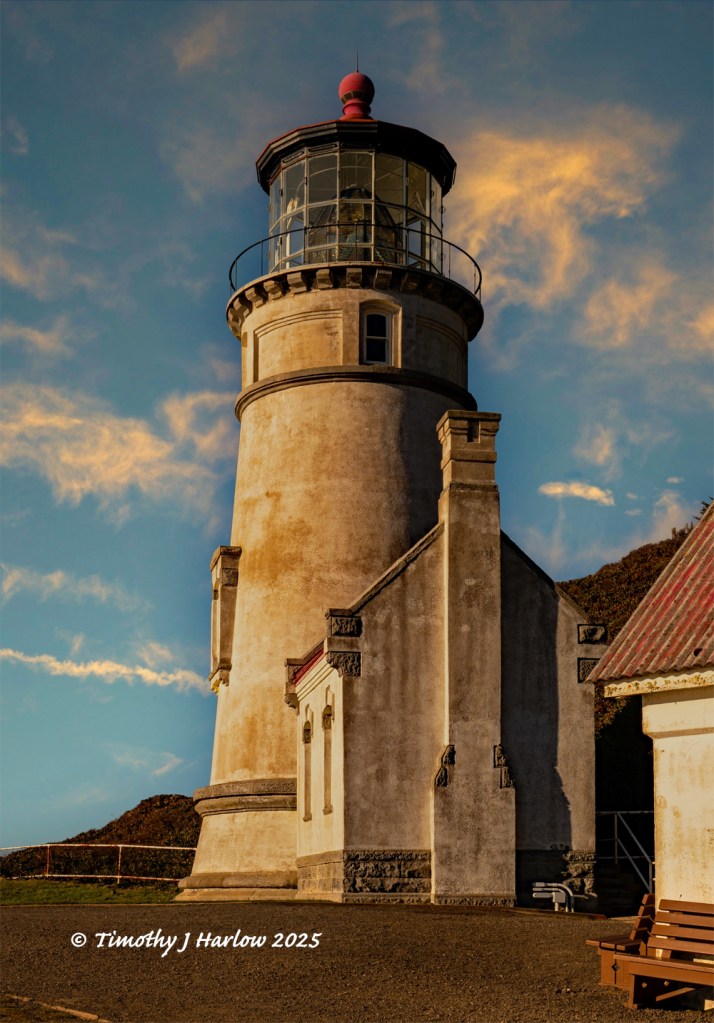
Since I chose to make my Oregon coast trip in January, the lighthouse was not open for tours. But the grounds are quite fascinating and offer some spectacular views of the Pacific Ocean and the coastline.
On the way back down the trail, I decided to stop at the Keeper’s house, which as I mentioned earlier, is now a bed and breakfast. There used to be another house for the assistant keeper, but that has been torn down now. Interestingly, the Keeper’s house is not located next to the lighthouse. Oh no! It’s nearly a half-mile hike from the Keeper’s house farther up the hill to the lighthouse.

Now, let’s ponder this for a moment. For us tourists, this hike is just a pleasant jaunt through the forest. But, for those keepers back in the late 1800s and earlier 1900s, this was quite a trip. Every single day – good weather, bad weather, freezing rain and snow, or hot summer sun – these keepers made this trek at least a couple of times a day. They had to make sure there was enough oil to keep the lamp burning and to make sure the lens was clean as well as the lighthouse lens room, so the beam could be seen clearly at night when it was most needed. Then they had to make sure the lens base was properly lubricated and could turn freely, and of course make any necessary repairs.
Now I think you’re getting the idea as to why these beautiful lighthouses are such an important part of our history – not just here in the US, but all over the world. These keeper’s had incredibly tough lives and were unbelievably dedicated to the mariners’ safety. If you read my post from a couple of years ago, Astoria and Fort Stevens, you will recall that the Oregon and Washington coasts are incredibly rugged and many, many ships have been lost on those coasts. These lighthouses were extremely useful in saving lives and ships. Even today, in 2025, the big coastal lights still serve as critical navigation aides.
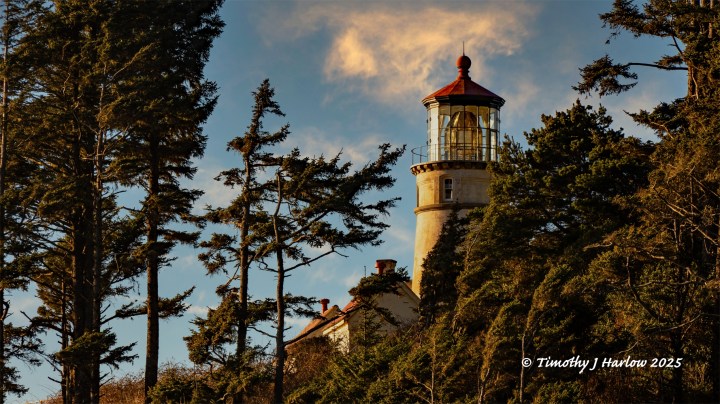
So, I hope this post about the Heceta Head Lighthouse and those wonderful First Order Fresnel lenses has given you a taste of the history of the Oregon coast and a hint of the beauty that waits for us on the Northwest coast.
Thank you so much for taking time to visit my blog. Spring is here, so it’s time to get out there and enjoy the outdoors, or for my southern hemisphere friends, winter’s coming so enjoy that wonderful light!
And I want to extend a special thanks to my friend at the Luna Sea Fish House in Seal Rock, Oregon for her recommendation to visit Heceta Head.


 Tim's Viewpoints & Visuals
One thought on “History and Highlights of Heceta Head Lighthouse”
Comments are closed.