


Two nights ago my wife was coming out of the barn, and noticed the large Hunter’s Moon just rising over Mt. Timpanogos to the east of our property. She told me to come out and check it out. This resulted in my first serious attempt at night photography in many years.
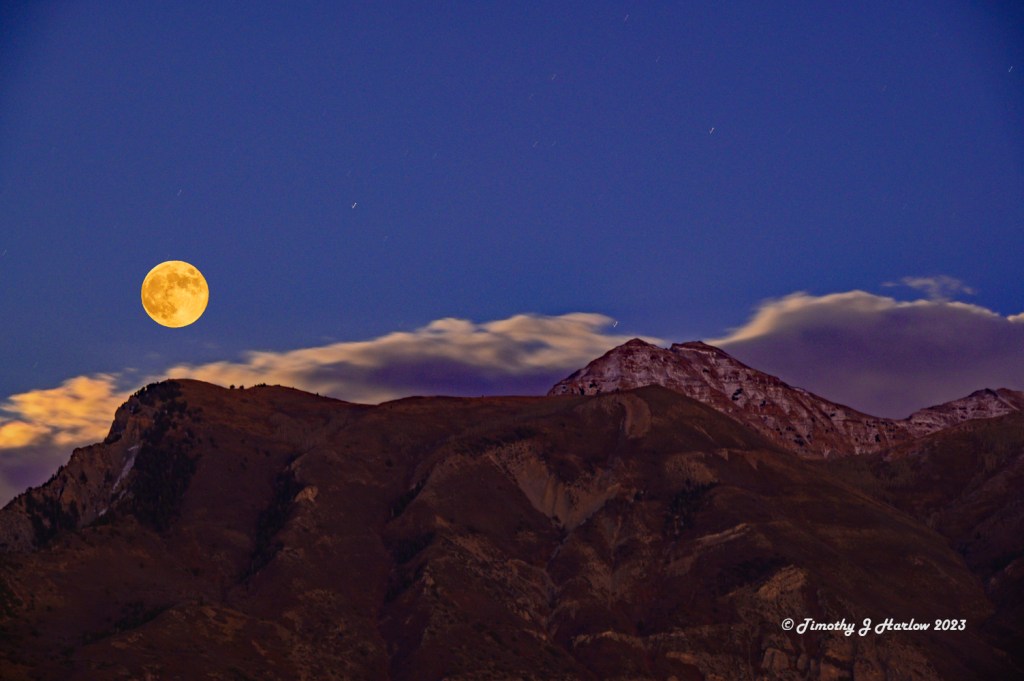
It required some time and a bit of study, as the moon is many times brighter than any moonlit landscape, and when trying to get the mountains right, the moon looks as bright as the sun. I decided the only way to do this was to take two separate photos – one just of the moon to get that the correct brightness. The next would be to just keep the moon out of the night landscape shot, and then just get that at the correct exposure and night time feel.
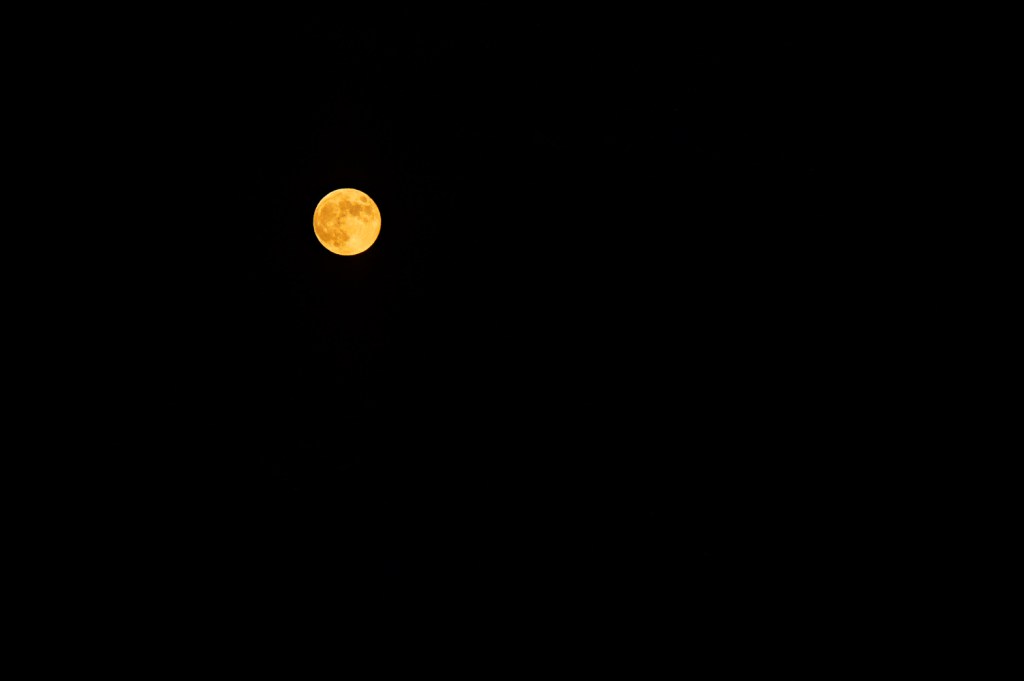
I exposed the moon at a daylight white balance to keep that yellow hue that we see with our eyes. As I mentioned above the moon was many times brighter than the mountains, so you can’t even see that there are the mountains below the moon. They are just pure black here.

I took the mountain landscape last night as the moon was just to the left of the photo. Again, I purposely kept the moon out the shot, otherwise it would just be a super bright whitish yellow highlight. And it would have been a huge distraction.
Using Photoshop Elements (my primary photo editing software), I selected the moon out of that first shot, and copied it to my clipboard. Then I made a few minor tweaks to the mountain landscape and opened a second layer in that photo. I pasted the moon onto that layer. And then I just re-positioned the moon to be about where it was while looking at the scene straight on.
And here is the finished product again. I am quite pleased with myself as this is the first night photography I have played with in a very long time. And I have never blended two completely separate photos together into one. It’s not perfect, but it’s not too bad for a first attempt.
I don’t know if the purists will think this combined photo is OK, but it is pretty close to what we saw in that evening sky. Anyway, I hope you enjoyed my narrative about the process. I am just happy to keep learning.
Thanks for taking time to visit my blog. Enjoy the wonderful autumn season.


 Tim's Viewpoints & Visuals
Nice image! Personally, my m. o. after 50 years of 35 mm shooting is taking pictures in natural light with no image manipulation. A photographer I met in San Francisco, who you might have heard of, Ansel Adams, told me that a great photographer should be able to take pictures with a box camera and an understanding of lens, perspective, and light theory. I’ve recently dropped my sophisticated Canon system and work with a cell phone, often very challengingðð. I do miss aperture priority currently but it adds to the challenge and artistry.
You make the road by walking it.
LikeLiked by 1 person
Thanks Ben! The one thing that I personally dislike the most about the phone cameras is their inability to handle higher dynamic range. From what I understand, that is simply a function of the small size image sensor.
But, I am definitely a fan of Ansel Adams, and studied his work and methods extensively in my younger days. I think the modern tech is allowing us to go farther with our images than the old film could ever go. But, can anyone ever beat an Ansel Adams black and white for perfect contrast, tone and exposure. He was a true master. Thanks for visiting and hope you all are well.
LikeLike
Wow, great tips. It is always a challenge for me to photograph what my eye sees in the night sky. Maybe I will adopt some of your technique.
LikeLiked by 1 person
You are welcome. Thanks for reading.
LikeLike